

Something fundamental shifted in digital marketing between 2020 and 2025.
Marketers realized their analytics tools couldn’t answer the most important question: Which campaigns actually drive revenue?
Fast forward to 2026, and marketing attribution software has become a $5.4 billion market powering how enterprises allocate advertising budgets.
This data compilation aggregates 100+ statistics from various sources such as Grand View Research, SNS Insider, Forrester, Gartner, providing journalists and analysts with verified market data, growth projections, regional breakdowns, and pricing insights.
How Big is the Marketing Attribution Software Market?
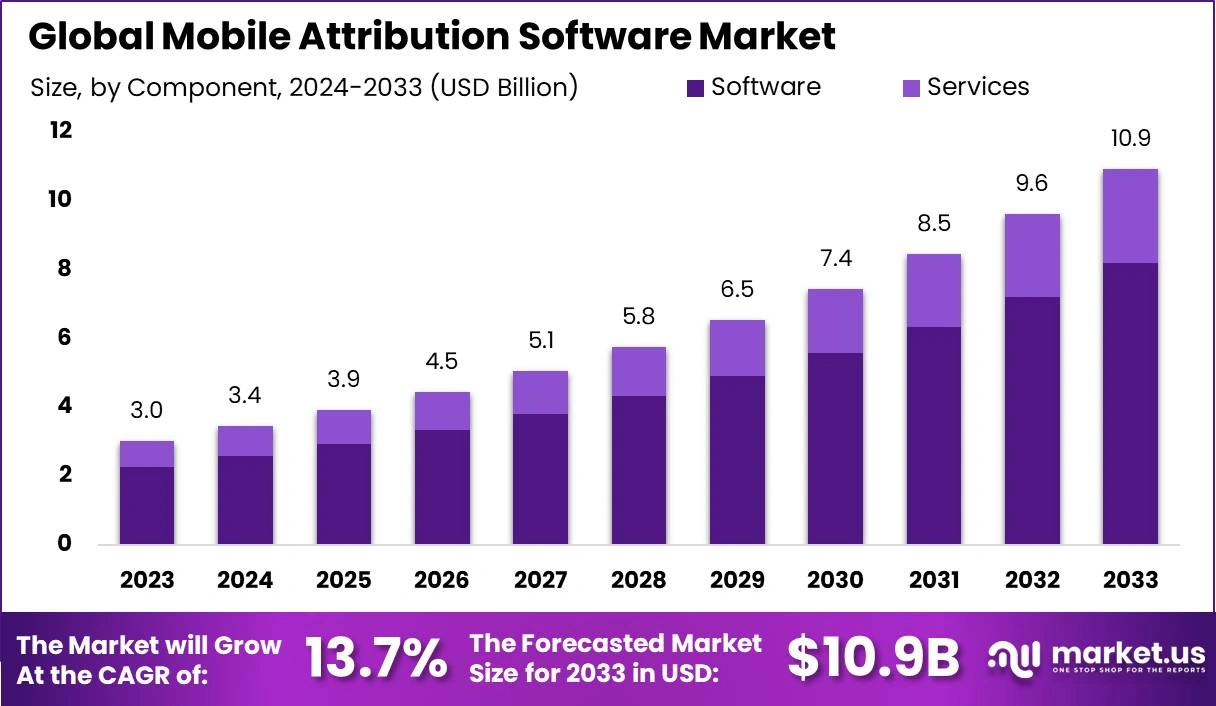
According to the latest data, the global marketing attribution software market reached $3 billion in 2023 and is projected to nearly double to $10.9 billion by 2033.
- The marketing attribution software market is growing faster than the overall marketing automation software market ($7.23 billion in 2025, projected to $18.36 billion by 2030).
- The market has nearly doubled in five years, accelerating from $3.1 billion in 2021 to $5.4 billion today.
- The marketing attribution software market is growing at a 13.6% CAGR from 2025 to 2030, significantly outpacing the overall marketing technology sector’s 9-11% average growth.
Marketing Attribution Software Market by Region
North America dominates the marketing attribution software market with 42% of global market share, but Asia Pacific is growing fastest at 15.7% CAGR through 2030.
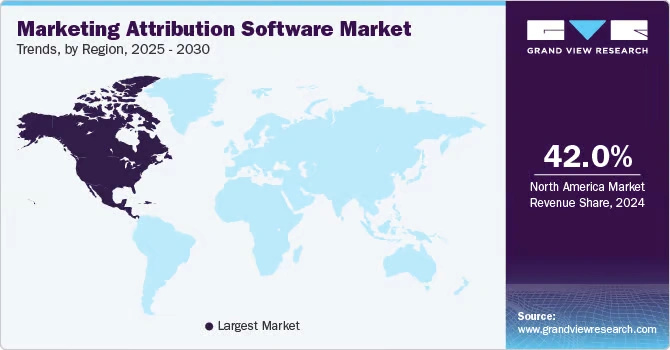
Here’s the complete regional breakdown:
| Region | Market Share | 2023 Value | CAGR | Key Characteristics |
|---|---|---|---|---|
| North America | 42.0% | $1.221 billion | ~13% | Largest market, mature adoption |
| Asia Pacific | 30.4% | $0.737 billion | 15.7% | Fastest-growing, e-commerce driven |
| Europe | ~25% | $0.928 billion | 12.3% | GDPR compliance focus |
| Latin America | ~8% | $0.357 billion | ~14% | Emerging market |
| Middle East & Africa | ~10% | $0.587 billion | ~13% | Developing adoption |
What drives North America’s dominance?
Advanced digital infrastructure, heavy marketing technology investment, and the presence of major vendors (Adobe, Salesforce, Google).
Companies in retail, technology, finance, and healthcare are investing heavily in attribution to optimize their digital ad spending.
Why is Asia Pacific growing fastest?
E-commerce expansion in China, India, and Southeast Asia is driving demand.
Mobile-first consumers, affordable SaaS platforms, and digital payment adoption are accelerating attribution software adoption across the region.
Marketing Attribution Software by Industry
IT & Telecom leads adoption with 22-27.2% market share, while Healthcare is the fastest-growing vertical at 15% CAGR through 2030.
Here’s the complete industry breakdown:
| Industry Vertical | Market Share | Growth Rate | Primary Use Case |
|---|---|---|---|
| IT & Telecom | 22-27.2% | ~13% | Subscription models, digital self-service |
| Consumer Goods & Retail | ~20% | ~14% | E-commerce attribution |
| BFSI | ~15% | ~13% | Compliance, high-value customer tracking |
| Healthcare | ~10% | 15% CAGR | Telemedicine, digital patient acquisition |
| Media & Entertainment | ~12% | ~14% | Content performance tracking |
| Travel & Hospitality | ~8% | ~13% | Omnichannel booking attribution |
| Digital Marketing (Application) | Largest | ~14% | Cross-vertical platform |
Why IT & Telecom leads?
The rise of subscription-based models and digital self-service platforms has made attribution critical for these industries.
Companies shifting toward digital-first user acquisition need to understand which online efforts lead to trial sign-ups, subscriptions, or upgrades.
Attribution tools help track the highest-performing marketing assets, enabling businesses to scale growth efficiently while reducing customer acquisition costs.
Why Healthcare is growing fastest?
The expansion of telemedicine and digital health services is driving explosive growth.
With more patients accessing healthcare remotely, digital marketing has become the primary channel for discovery and engagement.
Attribution software helps providers measure the success of telehealth promotions, app downloads, and digital appointment systems.
According to Market Research Future, the Digital Marketing application segment accounted for $2.176 billion in 2024 and is projected to reach $8.01 billion by 2035—representing the largest application category across all industries.
Marketing Attribution Market by Company Size
Large enterprises control 66% of market revenue, but small and medium enterprises (SMEs) are the fastest-growing segment at 14.5% CAGR through 2030.
| Company Size | Market Share | Growth Rate | Adoption Rate | Primary Driver |
|---|---|---|---|---|
| Large Enterprises (1,000+ employees) | 60-66% | ~13% | 85%+ (U.S. 100+ employees) | Complex multi-channel campaigns |
| SMEs (1-1,000 employees) | 34-40% | 14.5% | 44% (<$5M revenue) | Affordable SaaS platforms |
Why large enterprises dominate?
Companies with global operations, multiple product lines, and hundreds of marketing campaigns need sophisticated attribution systems that can process millions of interactions.
They typically use a mix of digital and traditional media—display ads, influencer campaigns, print, television, and in-person events—making it impossible to assess effectiveness without robust attribution frameworks.
Large enterprises also have the budgets to implement expensive solutions, with some spending $240,000+ annually just maintaining custom attribution systems (Marketing Evolution, 2024).
Why SMEs are growing faster?
The rise of marketing automation and CRM tools is democratizing attribution.
As more SMEs adopt platforms like HubSpot, Zoho, and Mailchimp, attribution integrations within these systems allow them to add advanced analytics with minimal technical complexity.
Attribution becomes a natural extension of existing workflows.
According to Marketing LTB’s 2025 data, 57% of companies worldwide now use some form of marketing attribution—up from approximately 40% in 2020.
Among companies with revenue exceeding $250 million, adoption climbs to 73%, with most using multi-touch models.
How Many Companies Use Marketing Attribution Software?
In 2025, 57% of companies worldwide use some form of marketing attribution in 2025, with adoption climbing to 73% among organizations with $250M+ annual revenue.
Here’s adoption by company segment:
| Segment | Adoption Rate | Key Insight |
|---|---|---|
| Overall companies | 57% | More than half now use attribution |
| Companies >$250M revenue | 73% | Enterprise standard, multi-touch dominant |
| U.S. businesses (100+ employees) | 85%+ | Near-universal in mid-market+ |
| B2B SaaS companies | ~65% | High penetration in tech sector |
| E-commerce businesses | ~60% | Transaction tracking priority |
| SMEs <$5M revenue | 44% | Rapid growth segment |
The adoption gap is closing fast. In 2020, approximately 40% of companies used attribution software. By 2025, that figure jumped to 57%—a 42.5% increase in just five years.
But there’s a sophistication problem. While adoption is widespread, implementation quality varies dramatically:
- 89-90% of B2B marketers use basic single-touch or simple multi-touch models (RevSure AI, 2025)
- 22% still rely exclusively on last-click attribution (Marketing LTB, 2025)
- 64% say their attribution doesn’t reflect reality (Gartner, 2025)
- 78% report attribution data doesn’t match revenue reports (Forrester, 2025)
This disconnect between adoption and effectiveness represents both a challenge and an opportunity for the market.
As companies realize their basic implementations aren’t delivering accurate insights, demand for sophisticated AI-driven attribution models is accelerating.
Attribution Model Adoption Trends
Despite industry evolution, 22% of organizations still rely exclusively on last-click attribution, while adoption of advanced models is accelerating toward 2028.
Here’s the current state of attribution model usage:
| Model Type | Current Adoption | Future Projection | Data Volume Required | Best Use Case |
|---|---|---|---|---|
| Last-Click (Single-Touch) | 22% exclusive use | Declining | Minimal | Simple transactional sales |
| First-Touch (Single-Touch) | ~15% | Declining | Minimal | Awareness campaign measurement |
| Multi-Touch (Basic) | 45-50% | Becoming standard | Moderate | Most B2B scenarios |
| Multi-Touch (Advanced) | 20-25% | Growing rapidly | High | Complex enterprise sales |
| AI-Driven/Algorithmic | ~10-15% | 60%+ by 2027 | 600+ conversions/channel/month | High-volume digital businesses |
Key trends shaping model adoption:
1. Multi-touch will become dominant by 2028. According to Marketing LTB’s research, multi-touch attribution is projected to replace single-touch as the standard model within three years. Among companies with revenue exceeding $250 million, 73% already use multi-touch models (LinkedIn/CaliberMind, 2025).
2. AI-driven attribution adoption will exceed 60% by 2027. As machine learning models become more accessible and require less technical expertise to implement, adoption is accelerating across both enterprise and mid-market segments.
3. The 89-90% problem persists. Despite technological advancement, the vast majority of B2B marketers still use basic attribution models that don’t account for complex, multi-stakeholder buying journeys. RevSure AI’s 2025 State of B2B Marketing Attribution report found that nearly 90% of respondents use single-touch or basic multi-touch models.
Why the slow shift to advanced models? Two primary barriers:
- Data volume requirements: Algorithmic attribution requires at least 600 conversions per channel per month to function reliably
- Implementation complexity: Advanced models require clean, integrated data from CRM, ad platforms, web analytics, and marketing automation—a technical challenge many organizations struggle to overcome
Marketing Attribution Software Pricing
Marketing attribution software pricing ranges from $50/month for basic SME plans to $500,000/year for enterprise CDP solutions.
Here’s the complete pricing breakdown:
| Pricing Tier | Monthly Cost | Annual Cost | Example Vendors |
|---|---|---|---|
| Entry (SME) | $50-$199 | $600-$2,400 | LeadSources |
| Standard (SME) | $199-$649 | $2,400-$7,800 | LeadSources, LeadsRx |
| Mid-Market | $649-$1,149 | $7,800-$13,800 | LeadSources |
| Enterprise Basic | $2,400+/month | $28,800+ | HubSpot Attribution |
| Form Attribution Tools | $50-$500/month | $600-$6,000 | LeadSources |
| E-commerce Attribution | $150-$2,000/month | $1,800-$24,000 | Hyros, Triple Whale |
| Enterprise CDP | – | $50K-$500K+ | Segment, Adobe, mParticle |
| Custom Implementation Maintenance | – | $240K average | Marketing Evolution data |
AI and Machine Learning in Marketing Attribution
AI-driven attribution adoption is expected to exceed 60% by 2027, with AI-powered models delivering 27-50% improvement in campaign performance compared to rule-based attribution.
Here’s the AI adoption trajectory and impact data:
| AI Attribution Metric | Current State | 2027 Projection | Performance Impact | Data Requirement |
|---|---|---|---|---|
| AI-driven adoption rate | ~10-15% (2025) | 60%+ | 27-50% accuracy improvement | 600+ conversions/channel/month |
| Algorithmic model growth | Fastest-growing segment | Dominant in enterprise | Up to 40% ROI improvement | High-volume datasets |
| Campaign performance lift | 27% average improvement | – | Real-time optimization | Google Marketing Platform data |
| Attribution accuracy gain | Up to 50% improvement | – | Reduced bias, pattern detection | Pimms.io research |
What AI enables in attribution:
- Real-time attribution adjustments: AI models process millions of interactions instantly, updating attribution weights as customer behavior changes—something impossible with manual rule-based models
- Predictive campaign optimization: Machine learning identifies patterns in historical data to predict which touchpoints will drive future conversions, allowing marketers to shift budgets proactively
- Automated credit distribution: Instead of marketers manually assigning attribution rules (40% first touch, 40% last touch, 20% middle), AI algorithms analyze actual conversion patterns to assign credit based on statistical impact
- Cross-device identity resolution: AI-powered probabilistic matching connects anonymous user behavior across devices with 60-70% accuracy (deterministic methods achieve ~95% but require login data)
The data volume barrier: Algorithmic attribution requires a minimum of 600+ conversions per channel per month to function reliably. This threshold limits AI-driven models primarily to high-volume digital businesses, e-commerce platforms, and large enterprises with substantial traffic.
Conclusion
That’s a wrap for my roundup of marketing attribution software market statistics.
The numbers tell a clear story: marketing attribution has evolved from a nice-to-have analytics tool into a $5.4 billion market projected to nearly double to $10.10 billion by 2030.
With 57% of companies now using some form of attribution and adoption climbing to 73% among enterprises with $250M+ revenue, attribution software has become standard infrastructure for modern marketing organizations.
But the market faces a critical challenge—78% of marketing leaders say their attribution data doesn’t match revenue reports (Forrester, 2025), and 64% of implementations fail to reflect reality (Gartner, 2025).
Despite widespread adoption, the majority of companies still use basic single-touch or simple multi-touch models that can’t accurately measure complex, multi-stakeholder buying journeys.
The opportunity ahead is massive. As AI-driven attribution adoption climbs toward 60% by 2027 and companies realize 20-40% ROI improvements with proper implementation, the market will shift from basic click tracking to sophisticated revenue intelligence platforms.
Multi-touch attribution will replace last-click as the dominant model by 2028, and algorithmic models will become accessible to mid-market companies—not just high-volume enterprises.
Geographic expansion will accelerate growth, with Asia Pacific growing at 15.7% CAGR (India at 23.5%) as e-commerce and mobile-first consumers drive demand.
Healthcare will emerge as the fastest-growing vertical at 15% CAGR, powered by telemedicine and digital patient acquisition. And SMEs will continue rapid adoption as affordable SaaS platforms democratize access to enterprise-grade attribution.
The bottom line: marketing attribution is no longer optional for businesses serious about marketing ROI. The question isn’t whether to implement attribution—it’s whether your implementation actually works.
Disclaimer: This article compiles statistics from leading market research firms including Grand View Research, SNS Insider, Allied Market Research, Persistence Market Research, Market Research Future, and analyst reports from Forrester and Gartner. All data is current as of January 2026. Market valuations vary slightly across sources due to different methodologies and base years.